The generation that put down the glass but not the emptiness
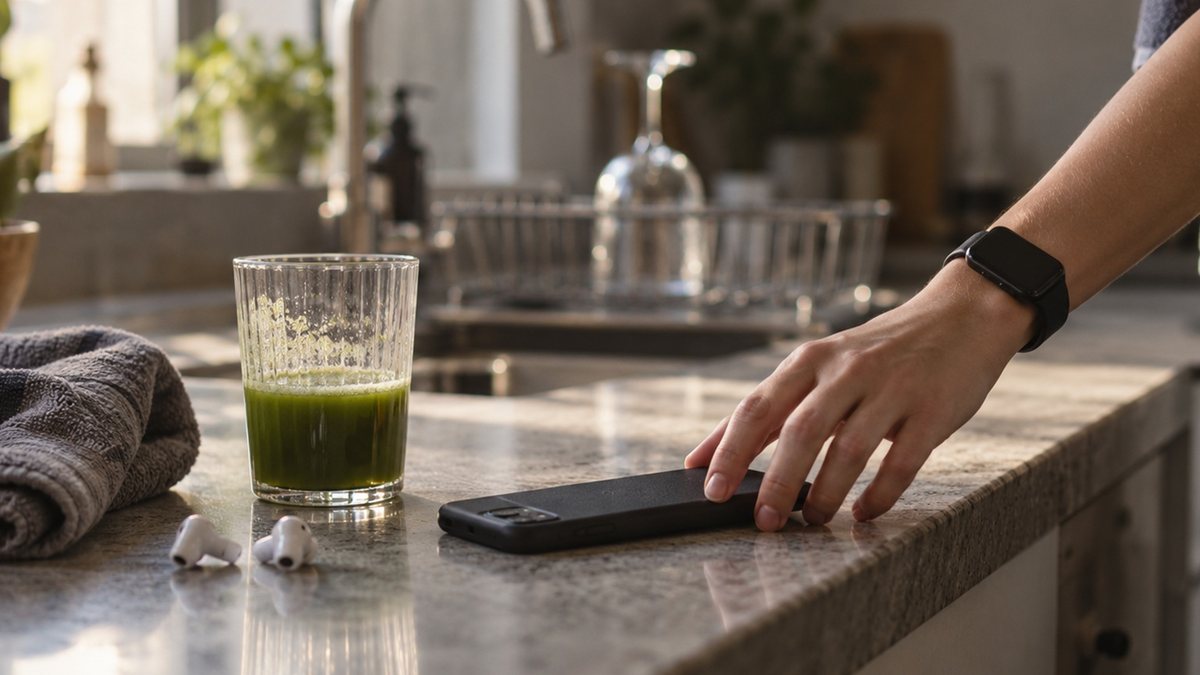
Young people today drink less than any generation ever measured, exercise more and eat better. That is a real achievement. But swapping the glass for a green juice does not guarantee that the emptiness the glass used to cover has gone away.
By Isabella Becker · 16 min read
English edition of Isabella Becker’s Portuguese essay, adapted for international readers. The article presents Virtology’s interpretation; its specific theoretical mechanisms should be distinguished from independently established clinical findings.
You do not drink, or you drink so little you cannot remember the last time. You get up early, you train, you watch what you eat, you know how many steps you took yesterday. And still, on some Sunday afternoon, with the house quiet and nothing new on your phone, an emptiness shows up that none of those things resolves. You did everything right, and it is still there.
Or maybe you are the mother or father of that young person. Your son or daughter stopped drinking, or never started. They go to the gym five times a week, drink green juice, post their running times. You breathed a sigh of relief, and you were right to.
This article is for both of you. And it begins with a caveat, so that no one reads what is not written. Exercising, eating well and not drinking are excellent. This generation’s health is likely to be better than that of the ones before it, and that is an achievement. A healthy habit, on its own, reveals no compulsion at all, and says nothing about how far someone has matured. What I want to show is something else: the object can change while the system that asked for the object stays the same. And that system is nobody’s flaw. Every human being has it.
The change is large, and it is worth seeing how large. The figures that follow come from O Que Nos Prende (What Holds Us), Eduardo Casarotto’s new book on addictions and compulsions.
In the United States, Gallup has been asking who drinks since 1939. In 2025, only 54% of adults said they drink, the lowest figure since the survey began. Among people aged 18 to 34, half. And 66% of those young adults think that even moderate drinking is bad for their health. Among American high-school seniors, the share who had drunk in the past year was 75% in 1997 and fell to 42% in 2024.
In Brazil, the movement is similar. CISA’s 2025 Panorama showed that young people aged 18 to 24 who did not drink even once in the year went from 46% to 64% in two years, and that heavy drinking at that age fell from 20% to 13%. Among students aged 13 to 17, having ever tried alcohol fell from 63.3% in 2019 to 53.6% in 2024, according to IBGE’s National School Health Survey.
The market followed. Non-alcoholic beer grew 9% worldwide in 2024, while regular beer fell. In 2018, the writer Ruby Warrington gave part of this movement a name in a book called Sober Curious: people who do not call themselves alcoholics but have started to question the habit of drinking on autopilot.
The bar is turning into a gym. The round of drinks is turning into a group run.
A real achievement
For generations, the glass was a symbol. The “down it, down it” chant at the bar, the expensive bottle in the middle of the table, the man who proved he was a man by holding his drink. In Eduardo Casarotto’s Virtology, human life in society moves through three waves: the wave of survival, the wave of power and competition, and the wave of identity and purpose. I wrote about them in Do you work to survive, to prove or to be?. The glass as a trophy belongs to the second wave.
And symbols of power fall when the need that created them disappears. They do not fall out of anyone’s kindness. They fall because they are no longer needed. That is what is happening to drinking as proof of strength. Casarotto calls this a civilizing process, and I agree with him: it is evolution, and it is very good that it is happening.
But right after that he asks a question, and this article grows out of it. Did these people change their band, or did they only change their wave?
The wave belongs to the world, the band belongs to you
The two words sound alike and speak of different things.
The wave belongs to civilization. It is the language of the time: what society applauds, what is in fashion, what looks good. The band belongs to the person. In Virtology there are seven Evolution Bands, from the Primitive Band to the State of Full Love and Charity, passing through Sensation, Predevelopment, Partial Consciousness, Feeling and Pretranscendence. The thread running through all seven is the place the other person occupies in each one’s perception. In the most primitive bands, the other is a threat or an object to be used. In Predevelopment, the other is a mirror: something to measure myself against. In Partial Consciousness, the other begins to have a reality of their own. In Feeling, the other becomes a full reality. I explained the bands in detail in Where are you in your own evolution?.
The way the two scales cross is simple to state: a person’s band determines the wave they are able to truly inhabit. Below Partial Consciousness, a person lives in the first and second waves, guided by survival, power and competition. In Partial Consciousness, they are between the two, already able to see the third wave but not yet living in it. Only in Feeling do they actually enter the third wave, because only there does the other stop being a mirror.
“Without feeling, ‘purpose’ is just a new word for an old structure.” — Eduardo Casarotto
So what happens when the culture changes wave and the person does not change band? They adopt the new language, the new objects, the new clothes. Inside, they keep working as before. They changed wave. They did not change band.
The same brain weighs the whisky and the green juice
To understand why this is possible, it helps to go down into the brain for a moment.
Just behind the forehead are two regions, the ventromedial prefrontal cortex and the orbitofrontal cortex, which take part in judging what is worth it. Deeper down, in the middle of the brain, is the ventral striatum, which contains the nucleus accumbens and takes part in motivation: it is what makes you want again whatever worked last time. Together, these regions form what neuroscience calls the valuation network.
The finding that matters here was described by Levy and Glimcher (2012). This network records the value of very different things, such as money, food, social approval, consumer goods and drugs, on one and the same scale. The brain converts things that cannot be compared into a single currency, so that it can choose between them. It is the common currency of value.
That explains something that seems strange. The brain does not have one drawer for whisky and another for green juice. It has a single scale. If the expensive whisky weighed a lot because it brought the feeling of being somebody, the photographed green juice can weigh a lot for the same reason. The liquid changed. What was being sought through it may not have changed at all.
In Virtology, what is being sought has a name. It is the need for Importance, one of the 51 human needs. And the system that looks after it is the SNO, the Pride Neurofunctional System (the Portuguese acronym is kept in the English editions). Pride, here, is not arrogance. It is the old system everyone carries, which wants to matter so as not to be left out of the group. And it measures importance in one way only: by comparison. I explained this system in Pride is not what you think.
When the SNO stays in charge, the swap happens almost without anyone noticing. Instead of the expensive bottle, the detox juice. Instead of the cigar, the six-pack. Instead of buying a round at the bar, the running time posted on the app. It is still the same need. Only the symbol changed.
When health becomes a shop window
Casarotto describes the clothes pride wears, and some of them fool everyone because they look like the opposite of pride. One of them is announced simplicity. “What I really like is plain rice and beans.” “I don’t care about expensive clothes.” When a person needs to announce this, they are asking for approval: I am worth more because I am simpler than you. He gives the example of the group that says “we don’t care about Ferraris here, we ride ox carts.” It looks like humility. It is the same pride, with another object.
The same thing can happen with health. I used to gain importance by being simple, and now I also gain it by being healthy. In an Australian study of 130 women aged 17 to 30, those who saw “fitspiration” photos, the images of toned bodies that are supposed to inspire, became more dissatisfied with their own bodies than those who saw travel photos (Tiggemann and Zaccardo, 2015). And those images did not even make people exercise more (Robinson and colleagues, 2017). They only increased comparison.
Exercise can also become a compulsion. A study of 1,665 gym-goers found signs of risk for exercise dependence in 30.7% of them, and in 60.2% of those who showed signs of an eating disorder (Trott and colleagues, 2020). The compulsions society praises, such as work, training and appearance, deserve an article of their own, and it is The addiction everyone applauds.
The question Humility asks in the face of all this is always the same. It is not what you have or do not have. It is not whether you drink, train or eat salad. It is whether you need it in order to be worth something.
The glass was the lid
In Virtology, before any desire there is a lack. Casarotto calls it the Lack of Unity: the background sense of not being whole, of being separated from something larger. It is not an illness or a character flaw. It is the condition of being born human. What changes from person to person is what each of us does with it.
For generations, we thought drinking, smoking and power would fill that hole. That the man with the expensive bottle, the car and the table full of friends at the bar would be complete. He was not. The Lack remained, because no object closes the Lack of Unity.
And there are already signs that changing the object has not closed the hole in this generation. Researchers studying the decline in substance use among adolescents in Europe and North America found that it followed the decline in evenings spent out with friends: the generation that drinks less also goes out less (De Looze and colleagues, 2019). In the United States, where the number of people who drink is at the lowest point on record, 25% of men aged 15 to 34 told Gallup in 2025 that they had felt a lot of loneliness the day before. And in Brazil, in the same survey in which trying alcohol declined, 26.1% of students aged 13 to 17 said that most of the time they feel nobody cares about them. And 18.5% felt that life is not worth living.
Drinking less did not cause this. Casarotto is clear on that point, and I want to be too. What is happening is that the two things are present together, in the same generation.
“The glass left. The emptiness stayed. Because the glass was never the cause of the emptiness. It was only the lid.” — Eduardo Casarotto
From there he makes a prediction, and I bring it as a prediction, not as a fact. The new generation is looking for completeness in a healthy life, with training and with purpose. That is much better than what came before. But if that purpose does not come from someone who no longer needs to prove anything, the emptiness will show up again. We have not yet seen the effect of this. Perhaps the next generation will.
Who you do it for
If you recognized yourself in the first paragraph of this article, you do not need to give anything up to start looking. Casarotto uses four questions to examine any object that may be covering the Lack: is it pleasure or relief, who do you do it for, what happens when no one sees, since when. I go through them one by one in Nobody smokes just nicotine. There the object is the cigarette or the glass, but they work just as well for training, for diet and for the glass you no longer drink. They do not produce a diagnosis. And answering them does not require stopping the habit to test your own willpower.
Here I suggest one more step, meant for anyone who swapped the glass for a habit everyone praises: watching that habit in practice, for one week.
A week with the habit that took the glass’s place
The goal is not to quit training or to start drinking again. It is to find out whether the new habit is taking care of you or carrying the same weight the old one carried.
Look at the symbol, not the object
Choose one habit. Training, the diet, the watch that counts your steps, the morning juice, the drink you turn down at the party. Just one.
Do it once without an audience. Train without posting or logging your time in the app. Eat without photographing the plate. Turn down the drink at the party without announcing that you do not drink. Once this week is enough.
Write down what came afterwards. Lightness, indifference, or a small drop, as if it had not counted. The drop is the clue that the habit was bringing you recognition.
Count the times the audience was consulted. Before choosing your clothes, your plate or the time of your workout, how many times did “what will they think” cross your mind? Do not try to silence the question. Just count. That number has to do with Individuation, which I talk about further on.
Look for something that gives you worth without becoming a photo. A lunch with someone, with no phone on the table. A conversation that will not become a post. An afternoon with a friend, with nothing to show for it afterwards. Notice whether that also leaves you at peace, even with no record of it.
If your notes point to recognition, that is no reason for shame. It is information. Pride is not a flaw some people have and others do not. It is an old system, and it only lets go of the trophy when it learns another way of knowing it has worth.
What parents can notice
If you are the mother or father of that young person, celebrate. The change is good. But observe, and observe with questions, not with surveillance. Do they train to take care of themselves or to be seen? Are they at peace with their body or at war with it? Do they have real friends, people they talk to without a screen in between, or followers of their workouts? Do they have a “what for” in life, something they want to build that does not fit in a photo?
And look inside your own home too, without accusation. The researcher Rebecca Puhl studied almost 14,000 people in a weight-management programme across six countries. Between 56% and 61% had experienced weight bias, and the most frequently cited origin was their own family (Puhl and colleagues, 2021). The joke about weight at Sunday lunch, the comparison between siblings, the “you’re getting chubby” said with affection. Nobody does this out of malice. It is the same SNO everyone carries, passed on without anyone noticing. Casarotto proposes a swap that is simple to state and hard to make: replace the ruler of the body with the ruler of character. Praise what your child did for someone, not how much weight they lost. That is what helps someone change band, and not only wave.
What changes the band
A band does not change by decision, nor by fashion. A person rises in band by practising virtue every day until it becomes a pathway in the brain. And in Virtology, no virtue works alone. The order follows the Pyramid of Virtues: first the Treatment Foundation, then Development, and the Top as the horizon.
Humility comes first. It is the virtue that acts directly on the SNO. Working on Humility, here, means no longer needing the trophy to be worth something, whether the trophy is the glass, the six-pack or the running time. When the hunger for importance eases, the symbol loses its shine on its own.
Selflessness comes paired with Humility, from the very beginning. It acts on the other old system, the SNE, the Selfishness Neurofunctional System, which weighs my gain against the other person’s. Selflessness brings the other person back into the scene. It is the workout that does not steal your child’s only free hour. It is the diet that does not turn Sunday lunch into a tribunal over everyone’s plate.
Then comes the rest of the Foundation, in no fixed order. Individuation is the one this generation needs most, and Casarotto gives it an easy marker to observe: the imaginary audience stops being consulted. In practice, you choose your clothes, your plate and your workout without asking yourself inside what others will think. Acceptance is making peace with the body that exists, not with the one in the photo. Responsibility takes a person out of the place of blaming others for their own emptiness. Perseverance shortens the time between failing and trying again.
For those who changed the object and kept the system, the canonical combination is the one for identity, Persona, authenticity and purpose: Humility, Individuation, Truth, Purity of Heart and Responsibility. Truth and Purity of Heart belong to Development and only hold once the Foundation is in place. Truth brings what you are closer to what you show. Purity of Heart has a lovely marker: you walk into a room without scanning it to see who is thinner, better dressed, more in shape.
For those who are still in the glass, the cigarette or another drug, and look at this healthy generation with shame, the canonical combination is the one for addiction, compulsion, impulse and immediacy: Humility, Selflessness, Truth, Gentleness, Patience, Responsibility and Acceptance. You do not need to imitate anyone. You need to overcome the same thing many of them have not yet overcome. Gentleness and Patience belong to Development and come after the Foundation. Further along, Pursuit of Improvement gives back real achievement, the kind that takes time, in place of the instant trophy. It requires Humility, Forgiveness and Perseverance first.
And Care for the Body, which seems to be the virtue of this whole generation, also belongs to Development. It requires Humility, Acceptance and Individuation first. Without them, care turns into a shop window, rejection or obedience to the group. With them, training changes meaning. In the Feeling band, the sentence that describes care for the body is this one: “I care for my body so that it can serve my purpose.” Food does not lose its flavor, training does not lose its joy. They lose the symbol.
At the Top, as the horizon, is Helping Others, and its marker says a great deal to anyone who lives by the photo: you help, and nobody finds out. That is where purpose stops being a new word.
What this generation can still gain
“The great victory will not come when nobody drinks anymore. Nor when everybody works out. The great victory will come when we actually overcome the SNO.” — Eduardo Casarotto
When that happens, a person trains because they care for the body they have, not to be applauded. They eat well because the body deserves it, not to show they eat better than the neighbor. They stop drinking because they no longer need any lid. And purpose appears as the natural place of someone who already knows they are whole and wants to care for others.
This generation has already made the most visible part of the change. The part that is missing does not show up in the photo, and that is exactly why it is the part worth training. Then the glass will be just a glass, and the green juice, just a juice.
If you drink every day and have decided to stop, talk to a doctor first. Alcohol withdrawal can be dangerous and sometimes needs medical supervision. Local addiction services can help you plan it safely. If training, food or the scale have started to run your life, please see a health professional as well. And if you, or your child, have been feeling that life is not worth living, that is urgent and not something to handle alone: contact local emergency services, or a crisis line in your country, right away.
Looking for a certified Virtologist, information about the training, or a partnership outside Brazil? Write to the international director for your region.
Want the whole framework, for yourself or to help others as a professional? Start with the short course, or take the full training with Dr. Eduardo Casarotto.
★ The full path · become a Virtologist
The Institute’s Professional Formation with Dr. Eduardo Casarotto is the complete training: the entire framework, the clinical method and the certification to practice.