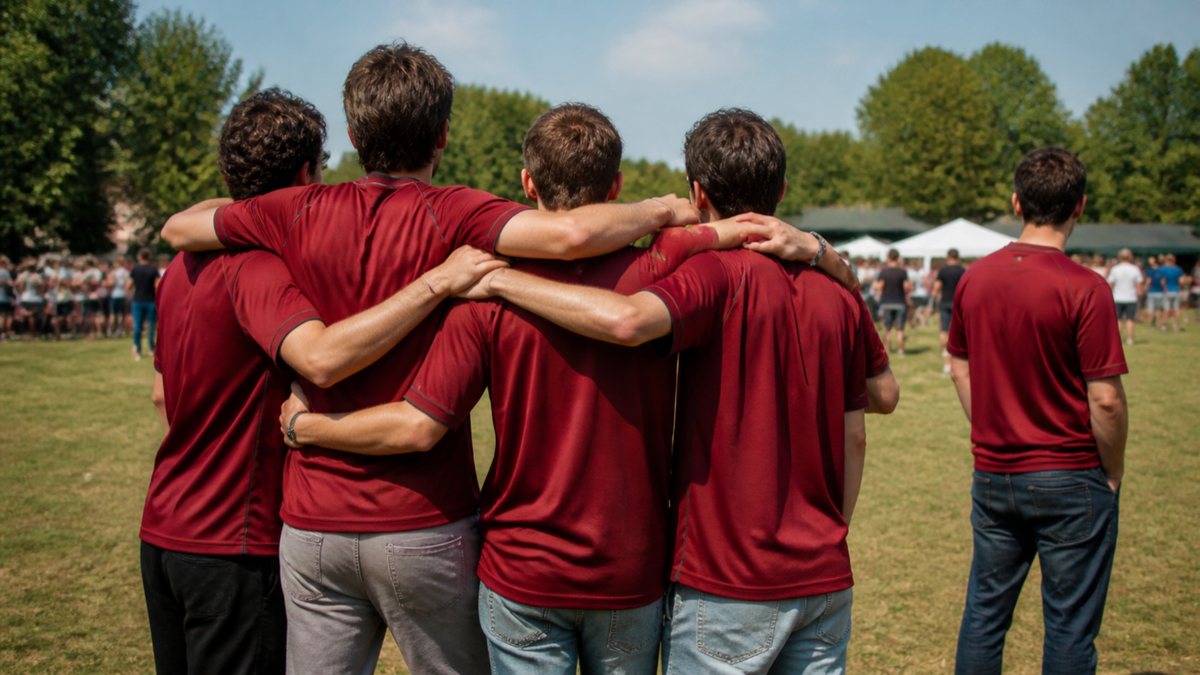
Oxytocin became famous as the love hormone. The studies show something else: it turns up the volume on everything social, including the urge to agree with your crowd and the sting of envy when someone else wins.
By Isabella Becker · 11 min read
English edition of Isabella Becker’s Portuguese essay, adapted for international readers. The article presents Virtology’s interpretation; its specific theoretical mechanisms should be distinguished from independently established clinical findings.
The phone buzzes on the table. It is the family group chat. Your cousin has sent a photo of himself leaning against a new car, the red bow still on the hood.
You type “Congrats, cousin! 🎉” in two seconds. The others send hearts. Your aunt writes that he deserves it.
You put the phone back on the table and notice something strange. You are happy for him, truly. And at the same time you feel a small sting in your stomach that you cannot explain, along with an urge to look at the photo again, just to check the model.
Both things are real. And the chemistry behind both is, to a large extent, the same.
The congratulations with a sting. You are glad about someone close to you getting something, and in the same minute you feel left behind.
The opinion that changes around the table. You arrived at lunch thinking one thing and left agreeing with everyone, without remembering when you changed your mind.
“Us” and “them.” On your team, in your neighborhood, in your church, among your colleagues, everyone seems reasonable. On the other side, everyone seems a bit stupid or a bit ill-intentioned.
The relief when the other person stumbles. Someone who was always showing off lost their job, and you feel sorry and also a little satisfaction you would never say out loud.
The fear of standing out. You know you disagree, but you say nothing, because speaking up would mean being left out.
None of these signs makes anyone a bad person. They show a system at work. Virtology has a name for it.
Pride, the way Virtology defines it
In Eduardo Casarotto’s Virtology, pride is not liking yourself or being happy about an achievement. It is the primitive need to matter in order to be accepted and approved by the group, and through that, to feel safe from the threat of not surviving.
The root of this need lies in the brainstem, the oldest part of the brain, the part that looks after breathing, heartbeat and alertness. Written there is a message every social animal carries: in a pack we survive. The cortex, the part that thinks, takes that urgency and turns it into a more demanding order: to stay in the group, I need to matter within it.
From then on, the brain keeps measuring the person’s position in relation to others. Virtology calls this system the SNO, the Pride Neurofunctional System (the Portuguese acronym is kept in the English editions). It runs a calculation that never stops: me compared with them.
Pride is not liking yourself. It is needing to matter so you are not left out.
And every group has its own currency of importance. In one, being simple is what counts. In another, having money. In another, being the smartest, the most devoted, the funniest. Whoever needs to matter learns the group’s currency and pays in it, almost always without noticing.
Keep these three pieces in mind: belonging to the group, paying in the group’s currency and running the comparison. They are going to appear, one by one, in the oxytocin studies.
The chemistry of bonding
Oxytocin is produced in the hypothalamus, a small region at the base of the brain that bridges the body and the emotions. It became famous for three things: childbirth, breastfeeding and bonding. It is the hormone that makes a mother put her young before herself, and that, in adults, goes along with the hug, trust and care.
In Caring for others calms the one who cares, I showed the most beautiful face of this system: oxytocin brakes cortisol, the stress hormone, and caring for someone calms the alarm of the person who cares.
That is why it earned the nickname “love hormone.” The nickname caught on in magazines, posts and talks. The laboratories told a more complicated story.
“Us” gets stronger
The Dutch psychologist Carsten de Dreu has spent much of his career studying oxytocin in groups. In 2010, he showed that in economic games between groups competing for resources, those who received oxytocin became more generous and trusting toward their own group and more defensive toward the rival group.
In 2011, he went further. He recruited Dutch men and gave some of them oxytocin as a nasal spray and the others a placebo. First he measured automatic associations, the kind a person makes without thinking: those who had received oxytocin linked more positive words to Dutch names than to Arab or German names.
Then he presented moral dilemmas. In one of them, five people will die unless one is sacrificed. When the person to be sacrificed had a Dutch name, participants on oxytocin hesitated more. When the name was foreign, they sacrificed more easily.
The bonding hormone did not make anyone more loving toward humanity. It made them more loyal to their own.
Oxytocin does not embrace everyone. It tightens the embrace around those who are already “mine.”
The herding hormone
In 2012, Mirre Stallen, also working with De Dreu, published a study whose title says it all: “The herding hormone.”
Participants rated how much they liked unfamiliar visual symbols. After each rating, they saw what other people had answered, either from their own group or from an outside group. Then they rated the same symbols again.
Those who received oxytocin changed their own opinion to move closer to the opinion of their own group. Faced with the outside group’s opinion, they did not change.
Nobody pressured anybody. There was no argument, no frown, no threat of exclusion. Knowing what the group thought was enough.
In Virtology’s language, this is the group’s currency being learned and paid in real time. The person does not decide to agree. They start to like what the group likes, and feel that the opinion is their own.
The sting of envy
The third study is the most unsettling. In 2009, Simone Shamay-Tsoory, at the University of Haifa in Israel, had volunteers play a game of chance against another person, who was actually a computer program. Sometimes the opponent won more money, sometimes less.
Those who received oxytocin felt more envy when the opponent won more. And they felt more pleasure when the opponent lost, which German has a word for, Schadenfreude.
The detail that matters: in the rounds where both won the same amount, oxytocin changed nothing, and it did not change general mood either. It changed only what depended on the difference between one and the other.
That is exactly the SNO’s calculation, me compared with them. The bonding hormone made the calculation louder.
When both won the same, nothing changed. What changed was how much it hurt to lose to the other and how good it felt to watch them lose.
Neither love nor hate: volume
How can the same hormone increase care and envy, trust and defensiveness? In 2016, Shamay-Tsoory and Ahmad Abu-Akel proposed an explanation that is now one of the most widely accepted, the social salience hypothesis.
The idea is simple. Oxytocin does not carry a feeling. It increases the importance the brain gives to social signals: a face, a tone of voice, a comparison, a sign of who belongs to the group and who does not. What it does with those signals depends on the context.
In a setting of bonding and safety, the loud volume of social signals becomes care, trust and closeness. In a setting of competition, comparison or threat, the same loud volume becomes envy, defensiveness and blind loyalty to one’s own group.
Oxytocin works like the volume knob on a radio. It does not choose the music.
Who is in command
This is where research meets Virtology, and it is worth separating what each one says.
The studies show that the chemistry of bonding amplifies whatever is already playing. Virtology says what is usually playing when pride is in command: the calculation of position, the need to belong at any price, the group’s currency. With the SNO in command, oxytocin works for it. It reinforces “us” against “them,” makes the person pay in the group’s currency and makes comparison hurt more.
This explains something many people find puzzling: people who are deeply attached to their own group, very warm with their own, can be cold or even cruel to those outside it. It is not a contradiction. It is the same system, with the volume turned all the way up and pride choosing the music.
The chemistry of bonding serves whoever is in command.
In Virtology, the virtue that takes pride out of command is Humility. It is the first virtue at the Base of the Pyramid and the only one that needs no other virtue before it. Humility does not erase the need to belong. The person still needs a place in the group. What changes is that they no longer need that place to be above someone, and no longer feel that standing out from the crowd means dying.
When that happens, the social volume stays high, but the music changes. The same oxytocin that fed comparison starts to feed care. The news about the cousin’s new car arrives and the sting is smaller, because the calculation of position has lost its force.
And Humility does not work alone. Its partner at the Base is Selflessness, the virtue that carries care beyond “us,” all the way to the stranger. Humility loosens the group’s boundary. Selflessness crosses it. Without Humility first, Selflessness becomes a performance. Without Selflessness after it, Humility has nowhere to go.
What is measured and what is interpretation
Two layers live together in this article, and separating them keeps it from claiming more than it can.
The first layer is research. The studies by De Dreu, Stallen and Shamay-Tsoory were published in serious journals, with control groups and placebos. The social salience hypothesis organizes these findings in a way many researchers accept.
There are important caveats. Almost all these studies used oxytocin nasal spray, and that method has a track record of results that do not hold up when other laboratories try to repeat them. Many used only men, in small groups. And measuring oxytocin in blood or saliva says little about what happens inside the brain. So the honest way to treat these findings is as pieces pointing in the same direction, not as a law of nature.
The second layer is Virtology’s reading. Nobody has measured “pride” in the sense Virtology gives the word, the need to matter in order to belong. Connecting these studies to the SNO, and concluding that Humility changes the music oxytocin amplifies, is the method organizing the findings. It is a reading consistent with them and useful in clinical work. It is not something a study has tested directly.
How this shows up in real life
Four scenes help to recognize the system.
The fan who goes to war. A calm man, a good father, a good neighbor, who at the stadium insults the opposing fans with a hatred that frightens his own wife. Outside the stadium, he is kind. Inside, “us” against “them” takes over. His bond with the other fans is real and warm. That same warmth becomes fury against anyone wearing the other shirt.
The opinion that is not hers. A woman who, in every group she spends time with, thinks like the group. With her college friends, she holds one political position. With her husband’s family, another. She is not lying in either place. She simply feels both as true, depending on the table. The work with her does not start with politics. It starts with the question of how much she needs to be accepted at each table.
The group he cannot leave. A man who has spent twenty years with the same group of friends at the bar. For a long time the conversations have bothered him: the jokes, the way they talk about women, the drinking that increases every year. He knows he no longer agrees. Even so, every Friday he is there, because the idea of not going brings a tightness to his chest that seems out of proportion. That tightness is the brainstem’s ancient alarm, the alarm of being expelled from the pack. It is not the bar he is afraid of losing. It is his place. The work with him is not to convince him to drop his friends. It is to help his brain learn that standing out is not dying, and that he can choose where he wants to be.
The congratulations with a sting. The opening scene. The person likes the cousin and is happy for him. The sting does not cancel the affection. It shows that, next to the bond, the calculation of position is switched on. With Humility, the affection stays and the calculation loses volume.
A practice for this week
The goal is to notice when your opinion is yours and when it is the group’s currency, and where the comparison calculation is switched on.
The group test
Choose a group you really like. Your family, old friends, coworkers, your church, your team.
Write down three opinions everyone in that group holds. About politics, money, food, raising children, anything.
Ask yourself, about each one: “would I think this if I had grown up in another group?” You do not need to change your mind. Just notice where the opinion came from.
Next time you feel the sting, name it. When someone close achieves something and you feel it, write one line: “the comparison calculation switched on.” No guilt and no disguise. It is just the system working.
Do something for the person behind the sting. A specific, sincere compliment about their effort, not about the result. That is Humility training the brain to link the other person’s achievement to the bond, not to a loss of position.
What changes when it changes
Oxytocin will keep rising at the family lunch, at the stadium, in the circle of friends. The volume of social signals does not go down, and it should not, because it is what keeps the bond alive.
What changes is who chooses the music. With pride in command, the loud volume becomes blind loyalty, borrowed opinion and envy disguised as congratulations. With Humility in command, the same volume becomes care, curiosity about the other person and joy at the achievement of someone close.
The cousin still has his new car. The difference is that the photo arrives, you send your congratulations, and your hand does not go back to the phone to check the model.
If comparison with others has been taking over your day, costing you sleep or bringing a sadness that does not lift, that deserves more than an article. Talking with a mental health professional helps you understand where that calculation comes from and turn its volume down.
References. De Dreu, C. K. W. et al. (2010). The neuropeptide oxytocin regulates parochial altruism in intergroup conflict among humans. Science. De Dreu, C. K. W. et al. (2011). Oxytocin promotes human ethnocentrism. PNAS. Stallen, M. et al. (2012). The herding hormone: oxytocin stimulates in-group conformity. Psychological Science. Shamay-Tsoory, S. G. et al. (2009). Intranasal administration of oxytocin increases envy and schadenfreude (gloating). Biological Psychiatry. Shamay-Tsoory, S. G.; Abu-Akel, A. (2016). The social salience hypothesis of oxytocin. Biological Psychiatry.
Talk to the Institute
Our international directors
Looking for a certified Virtologist, information about the training, or a partnership outside Brazil? Write to the international director for your region.
Want the whole framework, for yourself or to help others as a professional? Start with the short course, or take the full training with Dr. Eduardo Casarotto.
★ The full path · become a Virtologist
The Institute’s Professional Formation with Dr. Eduardo Casarotto is the complete training: the entire framework, the clinical method and the certification to practice.